About Us

WILD JAGUAR

About Pantanal Safari

The Pantanal is considered the worlds largest tropical wetland with 180,000 square kilometers and 80% of it being located in the Brazilian states of Mato Grosso and Mato Grosso do Sul.

Wildlife

The Pantanal has a seasonal fluctuation of water providing an abundance of life and rich fauna with 3.500 Species of plants, 656 Species of Birds, 263 species of fish, 113 species of Mammals, 41 species of Amphibians and 132 species of mammals, including ocelots, giant otters, tapirs and jaguars. The Pantanal is one of the best places in South America for wildlife safaris and the only place in the world you can photograph wild jaguars in their natural habitat.

tours, packages, pantanal, safari, wildlife, wild jaguar

In the Pantanal the connections between water is a natural phenomena that can be observed on different levels. Year after year, rains sculpt the region’s map. The Pantanal is characterized by strong, cyclical, yearly floods, which brings water and nutrients from a variety of different ecosystems. 

The Fauna and Flora of the Pantanal are influenced by the surrounding formations of Cerrado, Chaco, Amazon Rainforest, and Atlantic Forest. Thus, containing both essentially forest-based and open area elements with the biota that resembles that of the Cerrado, the Pantanal’s prevailing vegetation type. 

Northern pantanal

We are located in the northern Pantanal region of Mato Grosso and focus our tours in the State Park Meeting of the Water. The Park is 108,000 hectares and is thought to have the highest concentration of animals per square kilometer in the Americas becoming one of the best places in the world for ecotourism with its main attraction being jaguars, hyacinth macaws and giant otters. 

PANTANAL

HISTORY

tours, packages, pantanal, safari, wildlife, wild jaguar

These powerful beasts are regarded asa symbol of wildness and prominent in ancient religion and mythology. The Maya believed the jaguar was the God of the Underworld and helped the sun travel under the Earth at night, ensuring it would rise in the morning. 

Males are considerably larger than females. Size and weight vary considerably: weights are normally in the range of 65–150 kg (145-330 lb) and females are typically 10–20 percent smaller than males.

The jaguar (Panthera onca) is the third largest felidea species and the only living member of the genus Panthera in the Americas . 

WILDLIFE

The jaguar’s range extends from Southwestern United States and Northern Mexico, trickling through most of Central America, and south as far as Paraguay and Northern Argentina in South America.

Today They are listed as near threatened by the IUCN and large numbers on are only found in remote regions of South and Central America. Home to the highest population density of jaguars, estimated at between 4,000 and 7,000 animals in the Pantanal alone.

The name ‘jaguar’ is thought to derive from the ‘’Tupian’’or Tupi-Guarani word yaguara– yaguar, meaning “he who kills with one lap”. The specific word for jaguar is yaguareté, with the suffix –eté meaning “real” or “true”.

tours, packages, pantanal, safari, wildlife, wild jaguar

HABITAT

This spotted cat closely resembles the leopard, but is usually larger and more robust. It ranges across a variety of forested and open terrains, but its preferred habitat is tropical and subtropical moist broadleaf forest, swamps and wooded regions.

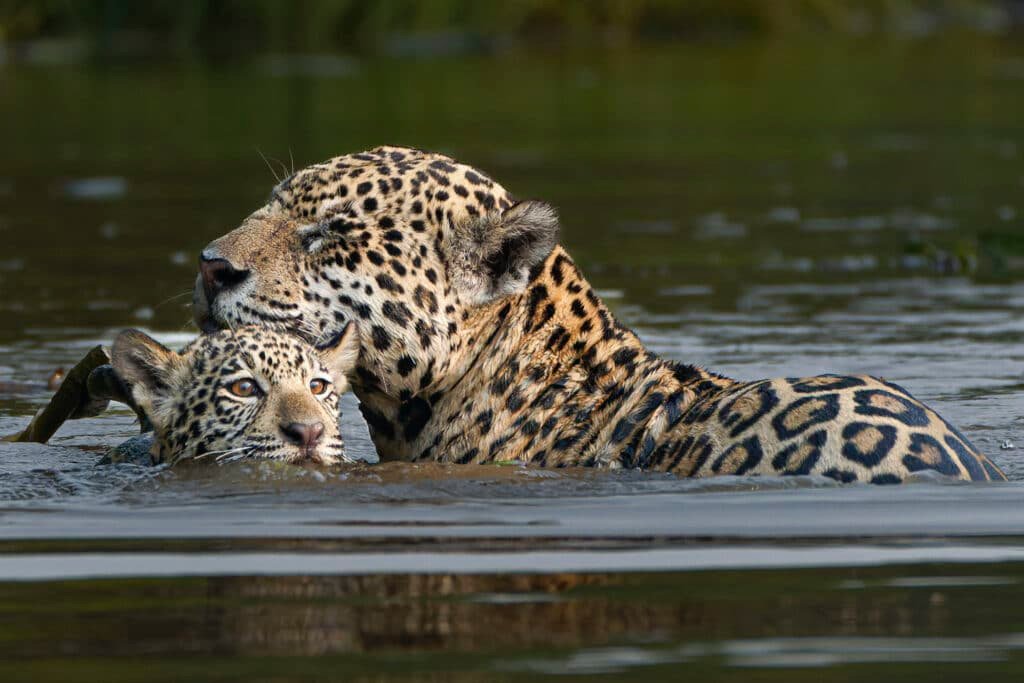
The jaguar enjoys swimming and is largely a solitary, opportunistic, stalk-and-ambush, apex predator.

As a Keystone species it plays an important role in stabilizing ecosystems and regulating prey populations. A clear difference between jaguars and leopards is the morphology, jaguars spots, or also known as rosettes, are larger, more exploded and usually have small dots in the center of the larger spots. 

tours, packages, pantanal, safari, wildlife, wild jaguar

Jaguars are known to have immense territories and documented home ranges of hundreds of miles. They mark their territories with urine, scent markings, and scratching trees. While these elusive cats once wandered throughout the Americas there is only an estimated 100,000 jaguars remaining in the word today. 

MORE CURIOSITIES

JAGUARS

The length, from the nose to the base of the tail, varies from 1.12 to 1.85 m (3.7 to 6.1 ft). A short and stocky limb structure makes the jaguar adept at climbing, crawling, and swimming. The head is robust and the jaw extremely powerful. Surprisingly, jaguars have the strongest bite of all big cats, which is thought to have evolved with their preference in armored reptilian prey, such as turtles and caiman.  A 100 kg (220 lb) jaguar can bite with a force of 503.6 kgf (1,110 lbf) at canine teeth and 705.8 kgf (1,556 lbf) at carnassial notch.

Jaguar females reach sexual maturity at about two years of age, and males at three or four. Jaguars are non-seasonal breeders and will mate any time of the year, though there are trend in birth peaks that correlate with prey availability. Jaguar are solitary predators, only coming together for courtship and mating, leaving the female to raise her young alone. Female estrus is 6–17 days out of a full 37-day cycle, and females will advertise fertility with urinary scent marks and increased vocalization. 

Females range more widely than usual during courtship. Gestation is roughly 100 days and can have from 1-4 cubs with an average of two. Cubs are blind and helpless at birth and do not leave the mothers den for the first two weeks. They begin hunting on their own at 6 months but stay within their mother’s territory for up two years. The lifespan for wild jaguars is 12-15 years and 16-25 in captivity. 


0 +

Years Experience

0 +

Animal Species

0 +

Pro Photographer

0 +

Pictures Taken

Terms & Conditions

If you use this website, you agree to the following terms and conditions:

Change to User Agreement

Wild Jaguar Photographic Safaris reserves the right to make changes to this site and this user agreement at any time without notice.

Booking with Wild Jaguar Photographic Safaris

In order to confirm our clients’ reservation, Wild Jaguar Photographic Safaris requires a 30% deposit payment at the time of making your booking. Failure to do so will result in your reservation automatically being cancelled. The balance of payment is due 8 weeks (60 days) prior to the commencement date of your itinerary. Bookings made within 8 weeks (60 days) prior to departure are subject to full prepayment at the time of confirming the reservation.

Please note that should you have been quoted in foreign currency and wish to settle payment by means of a credit card, your quotation will be converted to Brazilian Reais prior to the transaction being processed due to foreign exchange regulations by the Banco do Brasil. The rate of exchange on the day that the transaction is processed will be used to determine the equivalent Reais amount with any resulting foreign exchange differences or bank charges being for the client’s account.

Clients are welcome to settle payment by means of a bank transfer – in this instance the amount will be converted by your bankers on presentation of our invoice. It is the client’s responsibility to inform and instruct their bankers that the net invoice amount must equal the funds clearing into the Wild Jaguar Photographic Safaris bank account and that ALL bank charges are for the client’s account.

Travel Documents & Visa

It is your responsibility to ensure that you have valid passports, visas and re-entry permits which meet the requirements of immigration and other government authorities. Any fines, penalties, payments or expenditures incurred as a result of such documents not meeting the requirements of those authorities will be your sole responsibility.

Our Standard Cancellation Policy

– Prior to 8 weeks of travel – Full 30 % deposit is forfeited
– 8 – 4 weeks prior to travel – 50% of total cost is forfeited
– Cancellation less than 4 weeks prior to travel – 100% of total cost is forfeited

Check our payment methods.

General tips

INSTRUCTIONS

tours, packages, pantanal, safari, wildlife, wild jaguar

visa

To apply for a visa, foreigners must submit the completed visa application form, a valid travel document, proof of payment of consular fees, International Certificate of Immunization (when necessary), and other specific documents for the type of visa requested.

Consult the visa chart to verify if you need to have a visa to go to Brazil. Please make sure that your passport is valid for 6 months or more and check if you need vaccinations.

weather conditions

Pantanal has 2 very defined season; there is the rainy season (December to March) and the dry season (April to November). In both seasons the temperature is around 35°C (95°F).

Being September the hottest and driest month. If you have a trip on this time make sure that you have adequate UV protection gear. 

General Info for Wild Jaguar Safaris

ACTIVITIES – In the Pantanal we will do some short hiking along maintained trails; a few kilometers at max. During our jaguar safaris we will spend the entire day in a speed boat, which means there will be a lot of sitting during these excursions. We believe that our clients are looking for a experience in Pantanal and with jaguars, please keep in mind these jaguars are wild and can be unpredictable in whether or not they want us to observe them, so we choose to spend the day on the river. Wild Jaguar Safaris chooses not to come back during the lunch hours but instead joy a picnic style lunch. If we are lucky some times we will have lunch while watching the jaguar rest. We believe that this way we never lose the moment for an unforgettable memory. 

DISEASES – Pantanal is naturally a conservation wild area without pollution in the proportion of large cities so disease doesn’t affect the Pantanal area.

MONEY & TIP – Brazilian currency is the Brazilian Real. For your trip you might only need Reais for the small costs. At the hotels you can pay with credit card. It is better to bring with you some US dollars, as some lodges don’t accept any cards. 

WHAT TO BRING   

May have your own preference but please just check our suggestions. 

  • Light colored clothing for Safaris
  • UV long sleeves/t-shirts
  • Light weight pants
  • Long sleeved t-shirts 
  • Casual clothes for evenings 
  • Lightweight waterproof/ windproof jacket.  
  • Sweater/ Sweatshirt.
  • Waterproof shoes/ hiking boots. 
  • Sandals or casual shoes for evening
  • Hat or cap for sun protection 
  • Sunscreen & insect repellent 
  • Sunglasses with neck strap 
  • Flashlight (LED models)
  • Binoculars
  • Memory cards 
  • Camera
  • Medicine kit including all the medications that you usually need. If you have any allergy, please bring your own medicine.
  • Waterproof bag to bring all your stuff with you during the day. 
  • Outlet adapter/ ‘’NBR 14136’’ (Brazilian outlets). 
  • Rain-bag for camera gear 

WHAT TO BRING FOR PHOTOGRAPHY TOUR – Suggestion

  • Memory cards
  • Extra battery (You will spend all day out shooting jaguars).
  • Tripod and Monopod (Monopod can help you when walking out). 
  • Polarized filters 
  • Outlet adapter / ‘’NBR 14136’’ (Brazilian outlets). (Electricity 110V or 220V).
  • Laptop
  • External drive 
  • Rain-bag for camera gear.

Our Team

Team Jaguar Safari

tours, packages, pantanal, safari, wildlife, wild jaguar

Eduarda Fernandes

CEO & Founder

tours, packages, pantanal, safari, wildlife, wild jaguar

Juliana Rodrigues

RESERVATIONS

tours, packages, pantanal, safari, wildlife, wild jaguar

Marcos Félix

Wildlife Tour Guide

tours, packages, pantanal, safari, wildlife, wild jaguar

Pio

Pilot

tours, packages, pantanal, safari, wildlife, wild jaguar

Zaine Mohamed

WILDLIFE TOUR GUIDE

tours, packages, pantanal, safari, wildlife, wild jaguar

Rafael Hoogesteijn

veterinary medicine

The best time of year to visit the Pantanal is in the dry season from June to November. When the water get very low levels and animals as jaguars, capybaras, deers, and peccaries need to come closer to the water to get cooler, hunt, and drink water. The wildlife move more during the dry season looking for water and food.

The best time to see jaguars in the pantanal is during the dry season from June to November with its peak in October, when the level of the water goes down. Making the jaguars get closer to the river bank to hunt, drink water, mate and rest. It’s when beach and river bank stay sample, making the jaguars visible to see and photograph.

The pantanal is the best place to observes jaguars in the world and the chance to see the cat Is very high. According to the jaguar id project (jaguaridproject.com)
there were 886 sightings during the 2022 year. During the dry season and high
season in the pantanal the same project comes to report over 110 sighting per
month, that means an average of 3 sightings per day.

The right airpot to arrive is the Marechal Rondon airport CGB located in Varzea
grande/ Cuiabá , where ou time of guide and driver will be waiting for you for a trip
of 3 hours to the heat of the Pantanal. The first part of the trip is about 1hours
(100km) on a pavement road until the town Poconé, the last town before to get the
famous Transpantaneira highway where begins the Northern Pantanal. The rest of
the trip will be on the Transpantaneira witch is a dirty road of 156km.

All our trips includes all transfer form airport to hotel and hotel to airport. We pick
the clients in the airport and we drop off on the last day.

Our trip includes; Transfer, meals as break fast, lunch and dinner, water and sodas,
local and bilingual guide, nights safari, game drives, boat safari, accommodations.
Our trip do not includes; flights, visa, laundry, personal expenses, alcoholic drinks.

The value may vary according to the date, amount of people, durability, hotels and
services. For this reason I highly recommend you contact us to know how much you
will pay for your pantanal trip. However, we idealized special trips thought for small
groups of 4 to 6 pax with affordable values consistent with our service offered.
Remembering that we offer a high standard on services with new equipment and
idealized for better comfort for our clients. Our trips cost around US$ 400.00 per
night.

FAQs

Frequently Asked Questions

Lorem ipsum dolor sit amet, consectetur adipiscing elit. Ut elit tellus, luctus nec ullamcorper mattis, pulvinar dapibus leo.

Get Started

Photography Service to Experience the Beauty of Nature